Tambour embroidery: the hook behind Gulf couture
Most people have seen tambour work without knowing its name. If you own an abaya with a fine gold line scrolling across the cuff, or a kaftan with beadwork that somehow does not weigh the fabric down, you have almost certainly seen it.
What tambour embroidery actually is
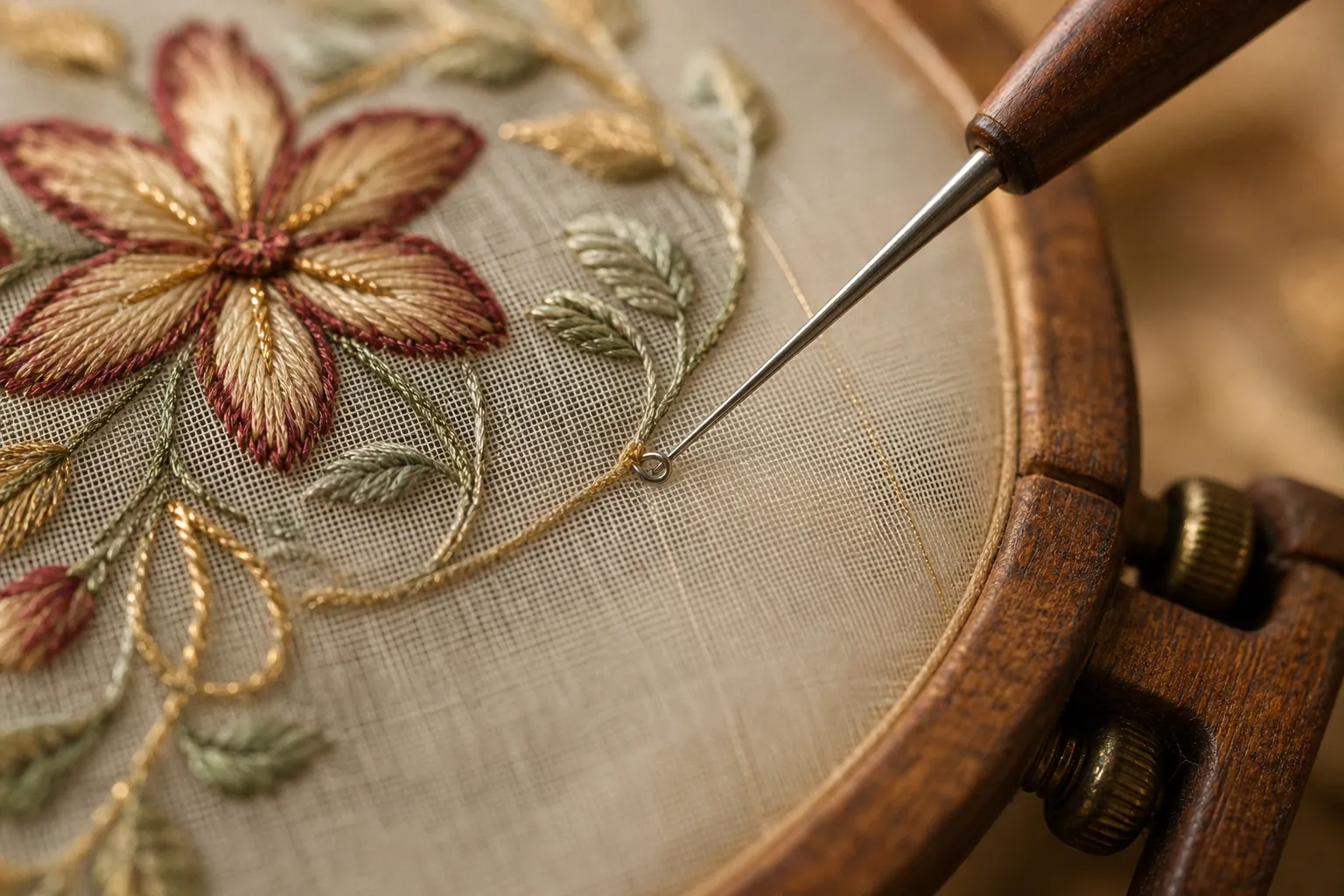
Tambour embroidery is worked with a small hook rather than a needle, on fabric stretched drum-tight in a frame. The word comes from the French for drum, which is exactly what that taut fabric resembles.
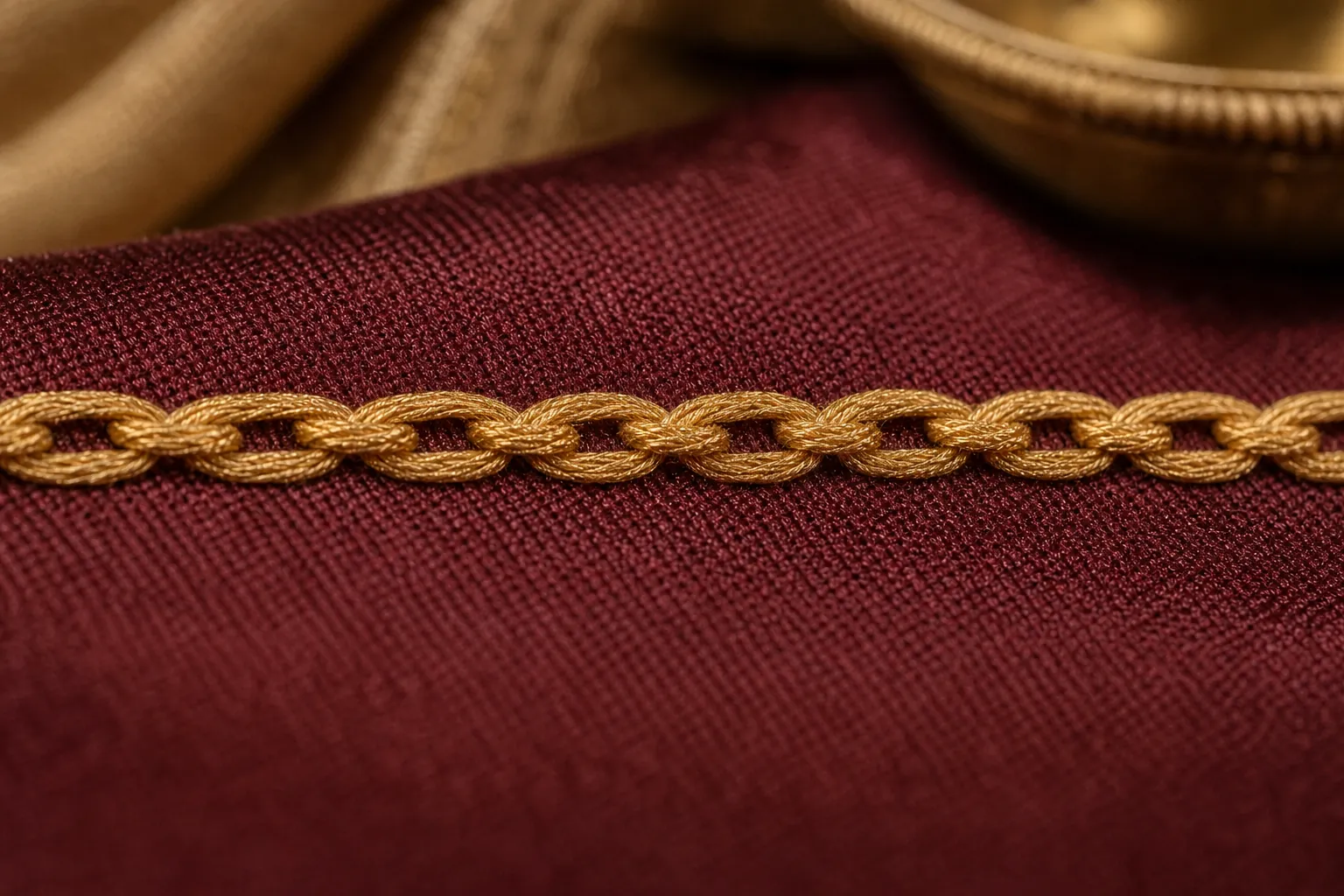
The craftsman holds the hook above the fabric and the thread below it. The hook is pushed through, catches the thread underneath, and draws a loop back up. Push through again inside that loop, catch, draw up — and you have a chain. Repeat at speed and a continuous chain-stitch line flows across the cloth.
That sounds modest. The consequence is not. Because the thread never has to be pulled all the way through the fabric and back, a tambour worker covers ground several times faster than any needle technique. This single fact explains almost everything about where tambour is used and what it costs.
Aari, Luneville, zalakdozi: one hook, many names
This causes genuine confusion, so it is worth being plain about it. These are largely the same technique under different names:
- Aari — the Indian name, after the hooked ari awl. What we call it in our Mumbai studio.
- Tambour — the English and general term, after the drum-tight frame.
- Luneville — the French name, from the town where the Paris couture houses refined it for beadwork.
- Zalakdozi — the Kashmiri name, traditionally on wool and namda.
There are real differences in tradition, tooling and typical materials — a Kashmiri shawl and a Paris gown are not the same job. But the hand movement is the same, and a craftsman trained in one can be taught the other. When a European atelier advertises Luneville beading and an Indian one advertises aari work, they are advertising the same underlying skill.
Why it suits abayas, kaftans and thobes
Gulf dress is built on fluid fabrics — crepe, chiffon, georgette, nida, fine organza — and on drape. A garment that hangs correctly is the whole point, and that creates a specific problem for embroidery: most techniques are too heavy.
Load a crepe abaya with dense needle work and the panel stops falling. It pulls, it sets into creases, it reads as stiff on the shoulder. The garment is spoiled, and no amount of beautiful stitching repairs it.
Tambour solves this in three ways.
- It is light. A chain line delivers a strong visual presence for very little added weight, so the fall of the fabric survives.
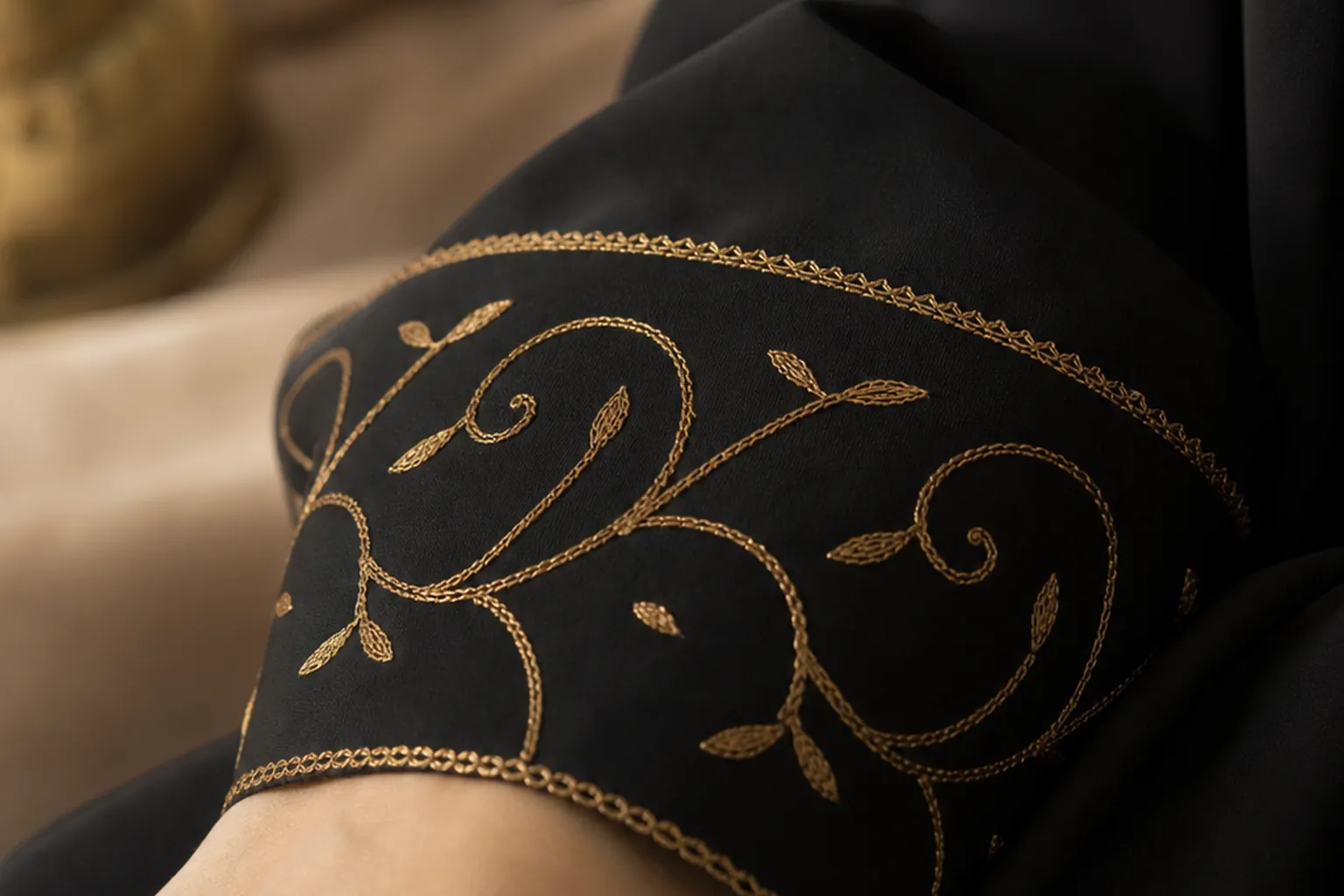
- It is continuous. Arabesque and scrolling vine patterns are unbroken flowing lines — precisely what a hook naturally produces. Needle techniques have to fake that continuity; tambour simply does it.
- It handles sheer fabric well. Fabric held drum-tight in a frame does not pucker, which is exactly the failure mode that ruins embroidery on chiffon and organza.
It is no accident that hook work dominates abaya and kaftan decoration from Dubai to Riyadh. The technique and the garment suit each other.
Beaded tambour, and why couture relies on it
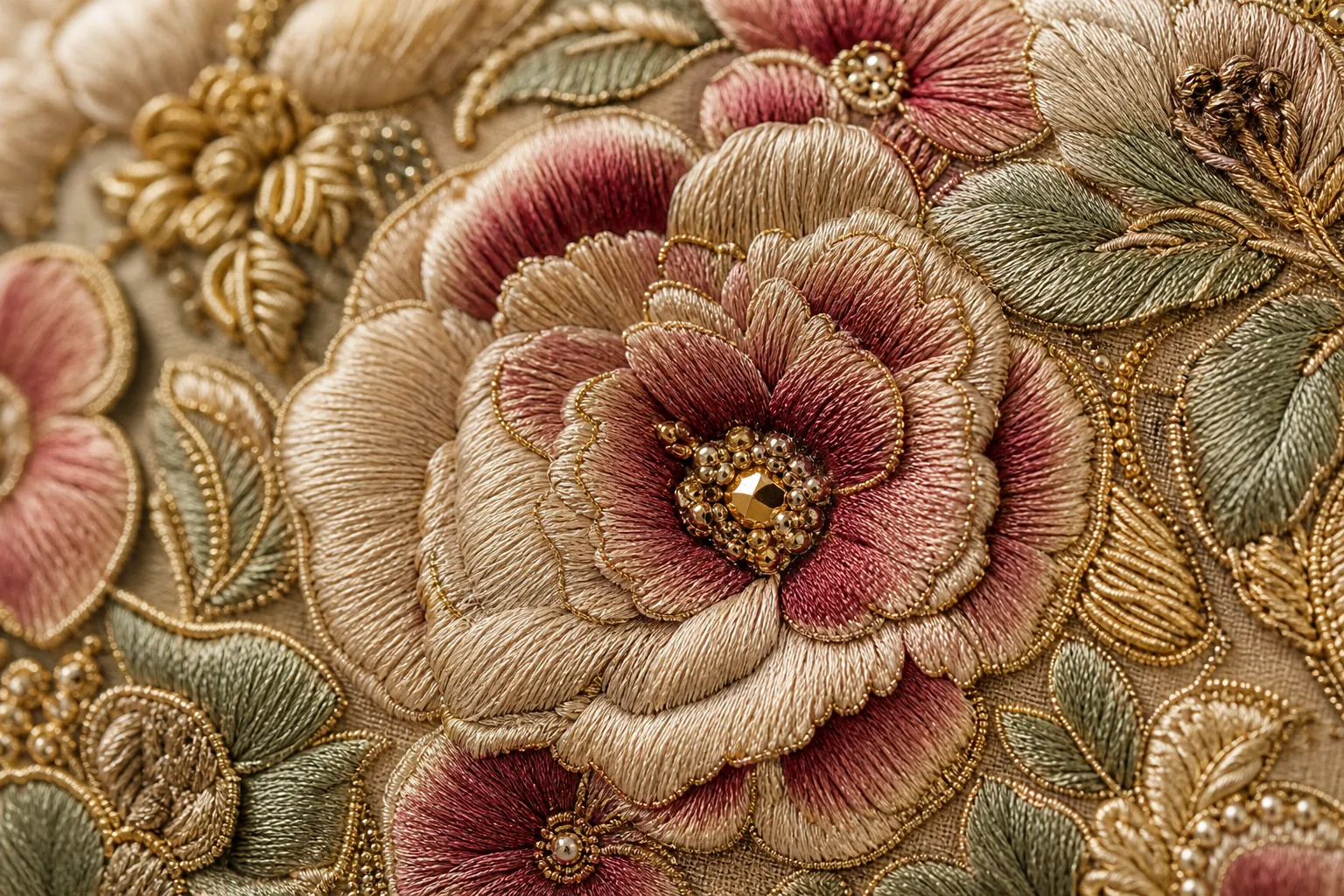
Here is the part most people do not know. Tambour is not only for thread — it is the fastest reliable way to apply beads and sequins, and it is how couture houses have done it for over a century.
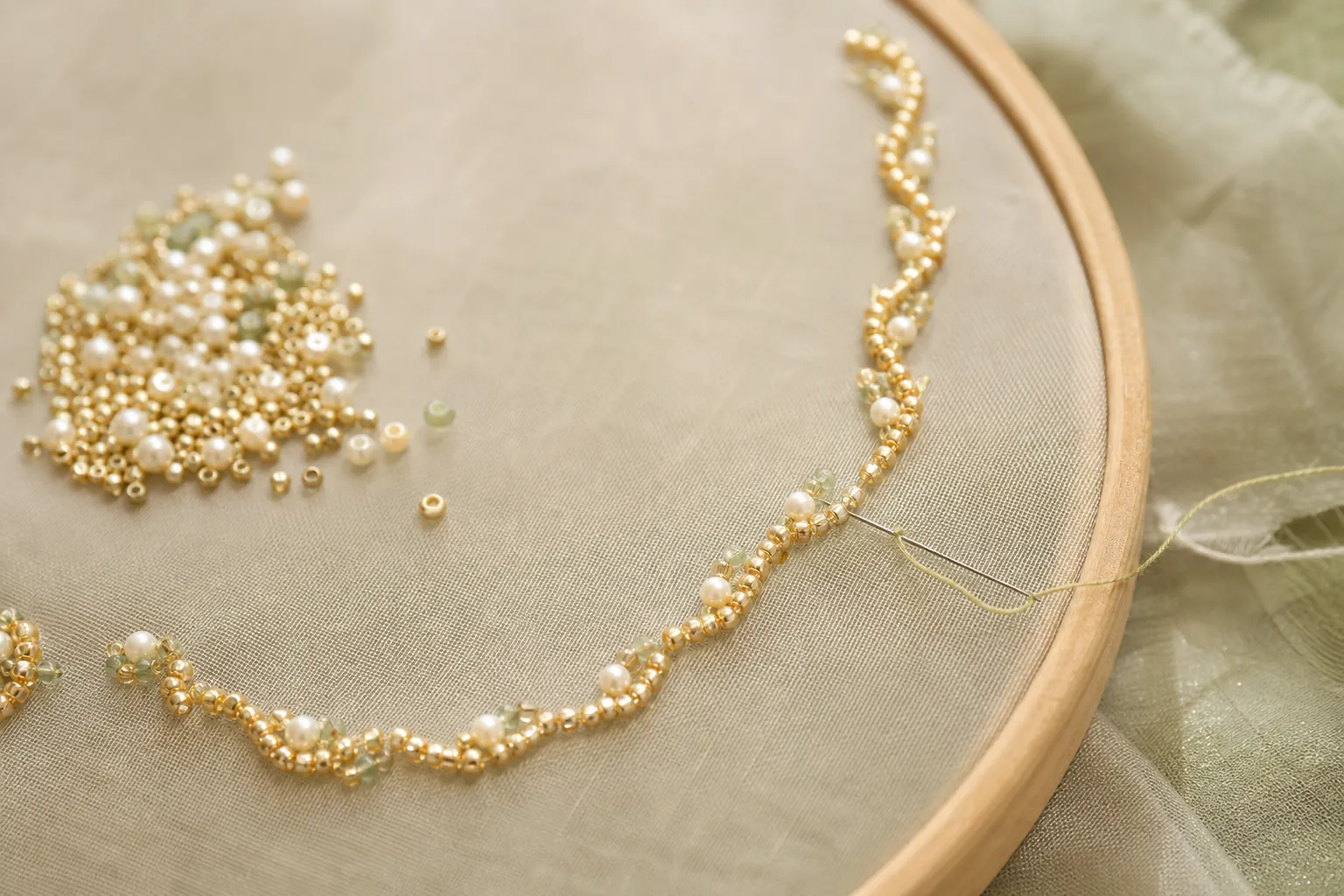
The beads are pre-strung onto the working thread, which sits below the frame. As the hook comes down and draws each loop up, it locks a bead into place on the underside. The craftsman works from the reverse of the fabric, essentially blind, trusting the design traced on the back and the rhythm of the hand.
It takes a long time to learn and it is remarkable to watch. It is also dramatically faster than sewing beads on individually with a needle, which is why heavily beaded couture is economically possible at all. For a kaftan with thousands of beads, the difference between tambour beading and needle beading is not a detail — it is the difference between a feasible commission and an absurd one.
Tambour or needle? An honest comparison
Tambour is not better than needle embroidery. It is better at particular things, and we will tell you when it is the wrong choice.
- Choose tambour for flowing linework, outlined motifs, scrolling borders, large areas of bead or sequin coverage, sheer and lightweight fabrics, and anything where drape must be preserved. Also choose it when budget matters — it is the best value of any genuine hand technique.
- Choose needle work for subtle colour shading, raised dimensional zardozi with dabka and nakshi, hand-set stones, and small areas of very high detail where the eye will linger.
- Often, choose both. This is what we usually recommend: tambour for the groundwork and the flowing structure, needle work reserved for the focal point. You keep the richness where it is seen and spend sensibly everywhere else.
On cost, tambour sits near the economical end of hand techniques — well below zardozi and hand-set stone work. We set out the full ranking in which embroidery is most expensive.
Commissioning tambour work from Mumbai
Aari and tambour work is daily work in our studio, not an occasional speciality. We work on abayas, kaftans, thobes, jalabiyas, gowns and bridal pieces, for clients across the UAE, Saudi Arabia, Qatar, Kuwait, Oman and Bahrain as well as throughout India.
Everything is embroidered by hand in our own studio in Dahisar East, Mumbai, by craftsmen we work with directly — nothing is outsourced to an unknown workshop or imported and resold. Finished pieces are couriered insured and tracked, and we have been sending work to the Gulf for years.
You can send your own fabric or a finished garment to be worked. For anything heading into production, we would encourage a sample swatch first — on sheer fabrics especially, seeing how the chain line reads against your actual cloth is worth far more than any description.
If you are ready, here is exactly what we need to quote. Regional pages with more detail: Dubai and the UAE, Abu Dhabi, and Saudi Arabia.
Tell us what you want made.
Send a reference photo, your fabric and your deadline. We reply with honest advice and a clear quotation.
Frequently asked questions
What is tambour embroidery?
Embroidery worked with a small hook instead of a needle, on fabric stretched drum-tight in a frame. The hook passes through the cloth, catches thread held underneath and draws up a loop, producing a continuous chain stitch. It is considerably faster than needle work, which is why it is used for linework and beading.
Is tambour the same as aari work?
Essentially yes. Aari is the Indian name for hook embroidery, tambour is the English term and Luneville is the French one. Traditions, tooling and typical fabrics differ, but the hand movement and the resulting chain stitch are the same.
Why is tambour used so much on abayas and kaftans?
Because Gulf garments depend on drape, and tambour is light. A chain line gives strong visual presence without the weight that makes crepe or chiffon hang badly. It also produces the continuous flowing lines that arabesque patterns are built from, and it handles sheer fabric without puckering.
Is tambour embroidery cheaper than other hand embroidery?
It is the best value of any genuine hand technique, because the hook covers ground several times faster than a needle. It sits well below zardozi and hand-set stone work in cost, while still being entirely hand-made.
Can you do beadwork with tambour?
Yes, and it is the fastest reliable method. Beads are pre-strung on the thread below the frame and locked in as each loop is drawn up, with the craftsman working from the reverse of the fabric. This is how couture houses have applied beadwork for more than a century.
Do you ship to Dubai, Abu Dhabi and Saudi Arabia?
Yes. We work regularly with clients across the UAE, Saudi Arabia, Qatar, Kuwait, Oman and Bahrain. Finished work is couriered insured and tracked, and you can send us your own fabric or a finished garment to be worked.
Are these made in India?
Yes. Every piece is embroidered by hand in our own studio in Dahisar East, Mumbai, by craftsmen we work with directly. Nothing is outsourced to a third party or imported and resold.
Still have a question? Message us on WhatsApp or send an enquiry.