Embroidery sample development for designers, boutiques and brands
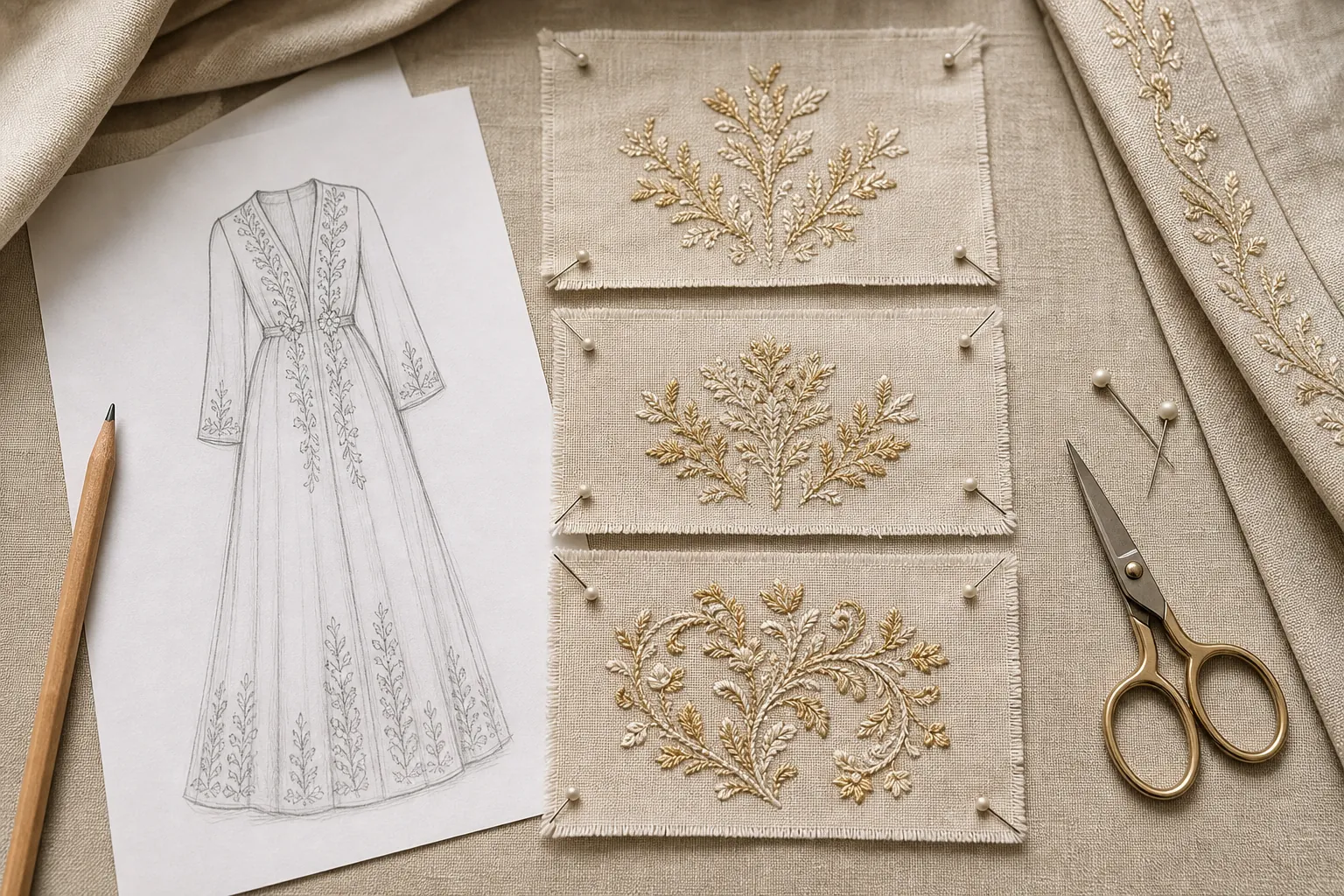
A sample is a small piece of the real thing — your design, your fabric, your thread, worked exactly as the final garment would be. It is the cheapest insurance in this trade, and for a production run it is not optional.
 MUMBAI • SINCE 1992
What a sample actually proves
Words and reference photos only go so far. A swatch settles the questions that cannot be settled on a screen, before they become expensive.
- How the thread reads against your fabric. The same gold looks warm on raw silk and cold on organza. You cannot judge this from a photo of someone else’s garment.
- Whether the density is right. Designers routinely ask for heavier work than the fabric can carry. A swatch shows the drag and puckering before it ruins a panel.
- How the piece behaves in light. Raised zardozi and flat zari photograph completely differently. If the garment is for a runway, a shoot or a wedding under lights, this matters more than the drawing.
- Colour matching. Dye lots move. Matching a thread to your fabric swatch in person is the only reliable method.
- What it will really cost at scale. Once we have worked the swatch, we know the hours. That turns an estimate into a firm per-piece rate for your production run.
Who sampling is really for
Any commission can be sampled, but it earns its keep most clearly in four situations.
- Fashion designers developing a collection, where the embroidery has to sit correctly across several pieces and be repeatable by more than one pair of hands.
- Boutiques and labels placing a production run, who need a fixed per-piece rate and a physical standard to hold the delivery against.
- Brands trialling a new supplier. A swatch is a low-risk way to judge whether our hand matches your standard before you commit a season to us.
- Anyone matching existing work — restoring an heirloom piece or adding to a garment that already exists. Here the sample is the only honest way to promise a match.
What we need to develop a sample
The more precise the brief, the more useful the swatch. Send what you have and we will tell you what else we need.
- Your fabric, or a cutting of it. Working the sample on anything else defeats the purpose.
- The design — a drawing, a reference photo, or a physical piece to match.
- The technique or the effect you are after. If you do not know the name, describe what you like and we will identify it.
- The scale: how large the motif sits on the finished garment.
- Your intended production quantity, if this is heading for a run — it changes how we work the swatch.
What happens once a swatch is approved
The approved sample becomes the reference standard for the whole order. It stays in the studio while your run is worked, and every piece is checked against it rather than against a memory of a conversation.
That is the real value of sampling for a production order: it replaces opinion with an object. If a delivered piece does not match the swatch, that is our problem to fix, and both sides can see it plainly.
If the first swatch is not right, we adjust and work another. That is a normal part of the process, not a failure — it is exactly what the sampling round exists for.
Your designs stay yours
A large part of our work is sampling and production for designers and labels, and most of it is unreleased when it reaches us. We treat it accordingly.
We do not display client commissions anywhere — not on this website, not on Instagram, not to other clients. Everything in our gallery is our own craftsmanship and materials rather than someone else’s finished order, and that is a deliberate choice. If your organisation needs a confidentiality agreement in place before samples are sent, that is routine and we are happy to sign one.
Cost and timing
We will not put a figure on this page, because an honest one does not exist in the abstract. A sample uses the same materials and the same skilled hours as the final piece, so what it takes depends entirely on the technique, the size of the swatch and the fabric.
What we will commit to is this: before any work begins, you will know what the sample involves, what it will cost and when you will have it — agreed with you in writing, in advance. Nothing starts without your confirmation, and nothing changes mid-way without asking you first.
Send your brief on WhatsApp and we will tell you where you stand, usually the same working day. If you are not sure what to include, here is exactly what we need.
Sample development questions.
What is an embroidery sample?
A small swatch of your actual design, worked in the real thread on your real fabric, exactly as the final garment would be made. It lets you judge density, colour, texture and how the work catches light before committing a full piece or a production run.
Do you charge for a sample?
It depends on the technique, the size of the swatch and whether it forms part of a production enquiry. We confirm whether there is a charge, and exactly what it is, before any work begins — you will never be surprised by it.
How long does a sample take?
It depends on the technique and what is currently on the frames. We give you a firm date when we accept the brief rather than a vague promise, and we tell you upfront if your deadline is not realistic.
Can I get a sample before placing a bulk order?
Yes, and for a production run we would encourage it. Once we have worked the swatch we know the hours involved, which lets us give you a firm per-piece rate instead of an estimate.
Will you sign a confidentiality agreement?
Yes. Much of our work is unreleased designer and label collections, so this is routine. We never display client commissions on our website, our Instagram, or to other clients.
Can you match embroidery on a garment I already have?
Yes, this is regular work. Send a photograph first, and send the physical piece if you can — matching an existing panel reliably needs the real thing in front of us, which is precisely why the sample round exists.
What if the sample is not what I wanted?
We adjust and work another. A sampling round that needs a second attempt is completely normal and far cheaper than discovering the problem on a finished lehenga.
Do you sample on fabric I supply?
Yes, and we prefer it. A swatch worked on a substitute fabric tells you very little, because how thread sits and how the fabric carries weight is most of what you are testing.
Still have a question? Message us on WhatsApp or send an enquiry.
Send a photo and five details, get a real quotation.
Same working day, from the people who will do the work.