Types of hand embroidery, explained plainly
Most embroidery guides list forty stitch names and leave you no wiser about what to actually ask for. This one covers the techniques that matter commercially, what each costs, and — importantly — the different names the same craft goes by.
The same craft, different names
The single most confusing thing about commissioning embroidery is that the same technique has a different name depending on who is describing it. People come to us asking for four different things and meaning one.
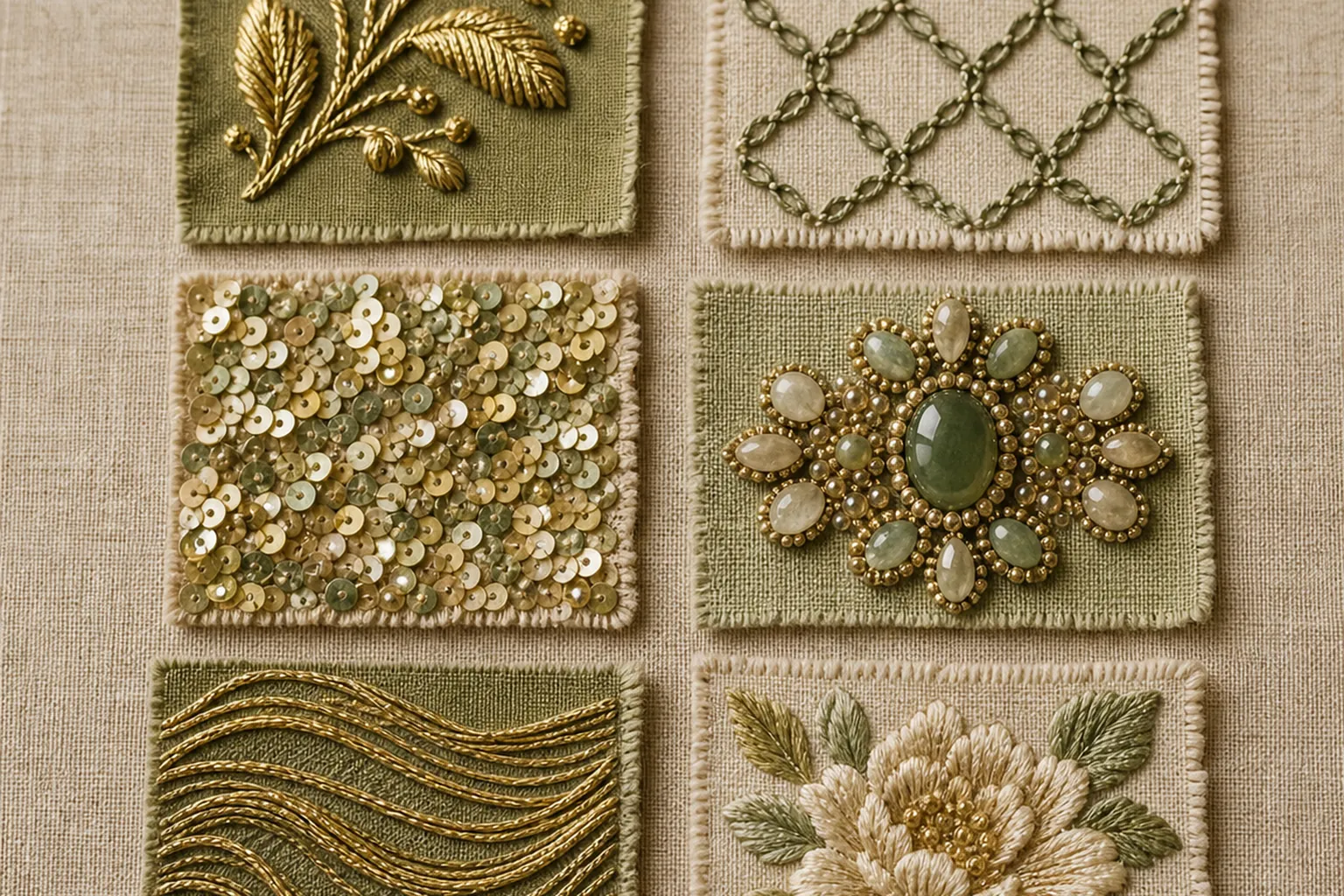
- Aari = tambour = zalakdozi = luneville — all hook-and-frame chain stitch. Aari in India, tambour in the Gulf, Europe and couture, zalakdozi in Kashmir, luneville when worked from the reverse to attach beads.
- Zardozi = zari-dozi — raised metal thread work. Literally “gold embroidery” in Persian.
- Zari — the metallic thread itself, not a technique. You can use zari in zardozi, in aari work, or couched flat.
- Dabka, nakshi, kora, salma — not techniques but materials: different coiled metal wires used within zardozi.
So if you have been given a word by a tailor, a relative or an Instagram caption, you do not need to decode it first. Describe the look, or send a photograph, and we will tell you what it is called and what it takes.
Aari and tambour hook work
A fine hook, worked from above through fabric stretched taut on a frame, pulling a continuous chain stitch. Because the hook does not have to pass fully through and back like a needle, it covers ground several times faster.
Suits: filled designs, florals, outlines, large areas. Cost: the best value per square inch of any hand technique. Watch for: it is a chain stitch, so it has a distinct look — lovely, but not a substitute for fine needle shading.
Zardozi and zari: the metal threads
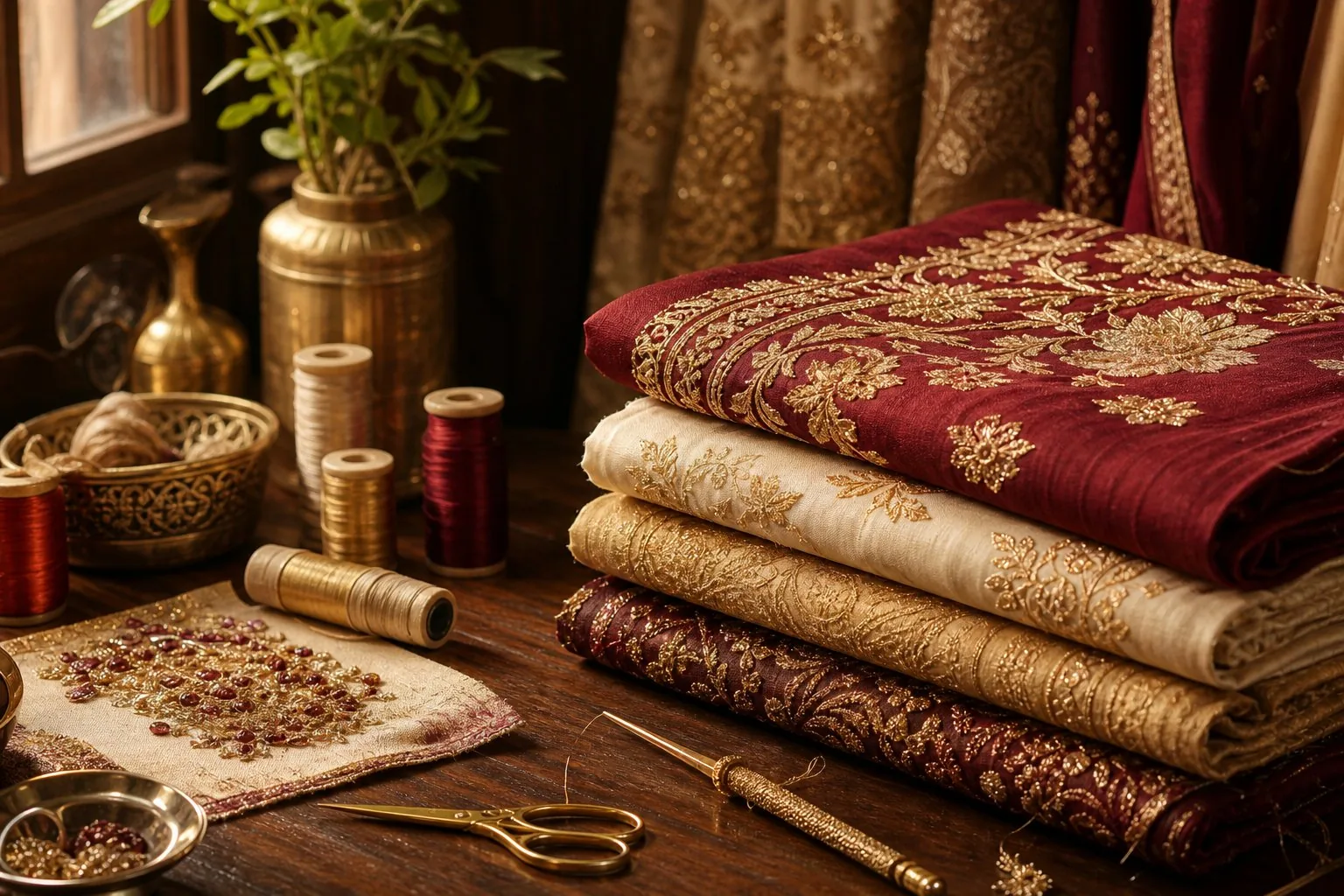
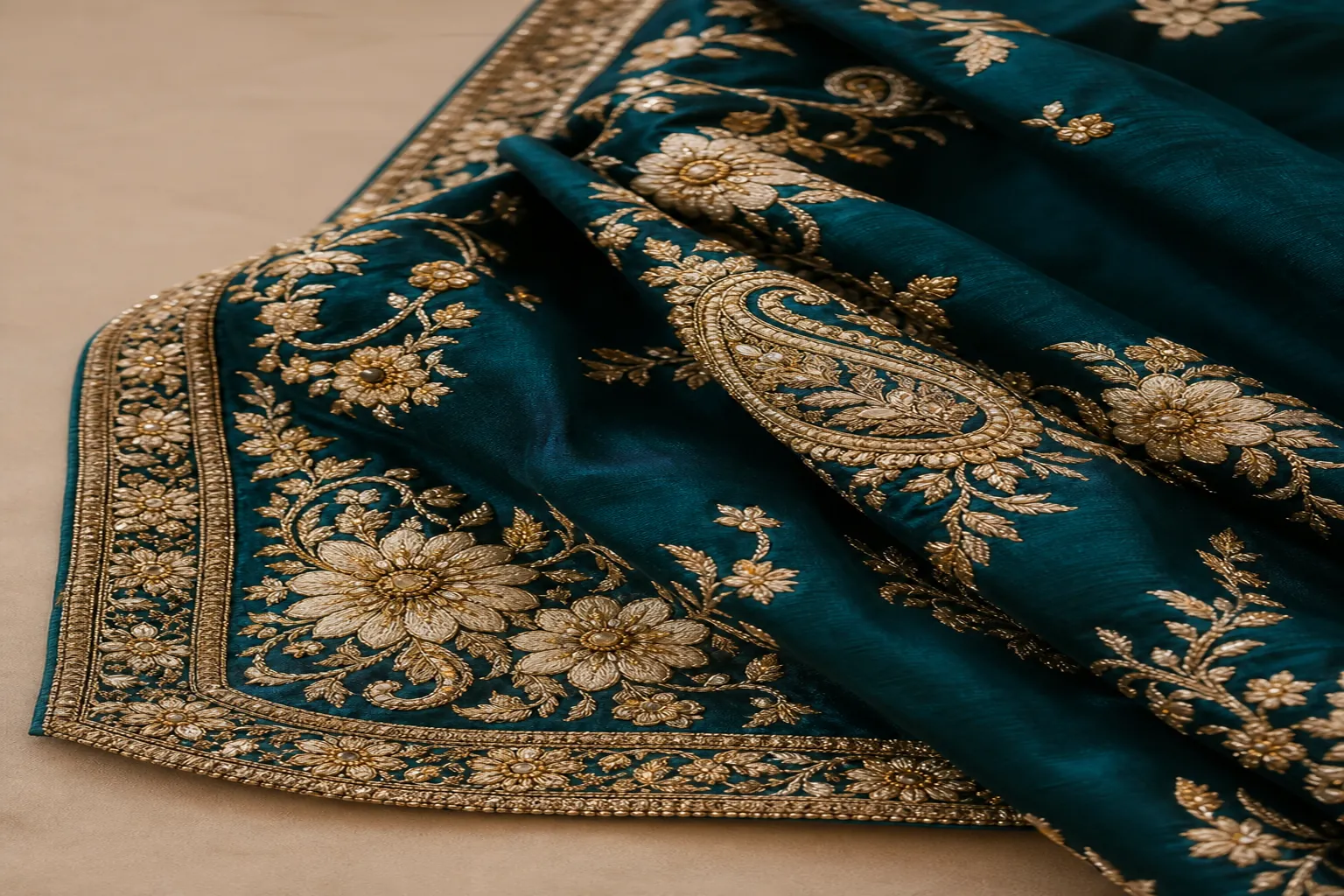
The heavy, formal, unmistakably bridal register. Raised metal elements are stitched down individually onto the surface, building real dimensional height.
- Dabka — tightly coiled wire, cut and stitched like a bead. The workhorse of zardozi.
- Nakshi — faceted coil that catches light from more angles.
- Kora — matte coil, used for contrast against shiny elements.
- Salma — fine smooth coil for outlines and delicate detail.
- Flat zari couching — metallic thread laid on the surface and stitched down. Flatter and more economical than raised work.
Suits: bridal, lehenga panels, formal Gulf goldwork, heirloom pieces. Cost: the most expensive per area, because every element is placed by hand. Watch for: weight. It needs a fabric that can carry it.
Thread and silk shading
Needle work in silk or cotton thread — satin stitch, long-and-short, French knots, stem and fishbone. This is where genuine artistry shows, because shading a petal convincingly is a skill that cannot be rushed.
Suits: florals, botanicals, portraits of detail, pieces meant to be examined closely. Cost: moderate to high depending on shading density. Watch for: it rewards close viewing, so it is somewhat wasted on a garment seen only from across a room.
Sequin, bead, stone and crystal
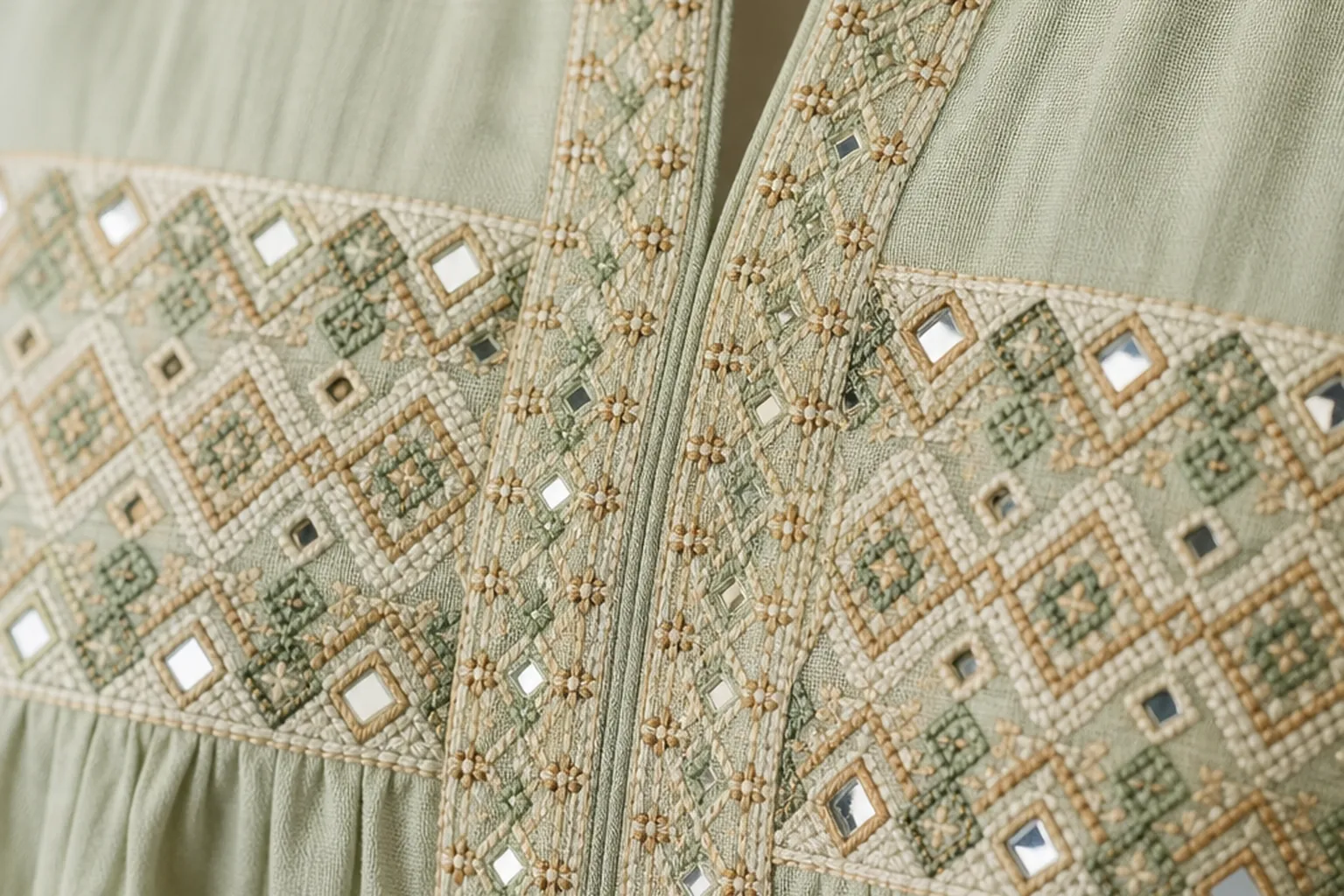
Everything that catches light. Sequins and cutdana for shimmer, hand-set stones and crystals for sparkle, pearls for softness, mirror (shisha) for a bolder regional look.
Suits: evening and occasion wear, anything photographed under lights. Cost: material cost plus labour; varies hugely with density. Watch for: hand-set is not glued. Glued stones fail in the wash and look it. Ask which you are getting.
Regional traditions
India has dozens of regional schools. These are the ones customers most often ask us about by name:
- Kashmiri / zalakdozi — chain stitch, florals and chinar leaves.
- Kutch and Gujarati — mirror work, bold geometry, strong colour.
- Lucknowi chikankari — white-on-white shadow work, exceptionally fine.
- Bengali kantha — running-stitch, soft and textural.
- Khaleeji goldwork — the Gulf tradition: dense gold plackets and scalloped necklines.
- Najdi and Sadu-influenced — Saudi geometry, angular and architectural.
We work aari, zardozi, zari, thread, embellishment, mirror and both Gulf traditions as daily studio work. Where a tradition is outside what we do properly, we say so rather than approximate it — an approximation of chikankari is not chikankari.
How to choose
You do not need to arrive with the right word. Answer these four and the technique chooses itself:
- What is the garment, and what fabric is it?
- Will it be seen close up, or across a room?
- Is it a one-off or a run of pieces?
- What is the budget, honestly?
Send a photo with those four answers and you will get a recommendation and a real quotation the same working day — including, when it applies, the advice that a cheaper technique would give you ninety per cent of the look.
Tell us what you want made.
Send a reference photo, your fabric and your deadline. We reply with honest advice and a clear quotation.
Frequently asked questions
What is the difference between aari and tambour embroidery?
There is none — they are the same hook-and-frame chain stitch technique. Aari is the Indian name, tambour the European and Gulf one. Zalakdozi is the Kashmiri term and luneville is tambour worked from the reverse for beading.
What is the difference between zari and zardozi?
Zari is the metallic thread itself; zardozi is the technique of stitching raised metal elements onto fabric. You can use zari thread without doing zardozi, for example by couching it flat.
Which type of hand embroidery is cheapest?
Aari or tambour hook work in thread, kept to outlines or light fill. It covers ground faster than any other hand technique, so you pay for fewer hours.
What is dabka, nakshi and kora?
They are materials, not techniques — different coiled metal wires used within zardozi. Dabka is tightly coiled, nakshi is faceted to catch more light, and kora is matte for contrast.
Do you do chikankari or kantha?
Our daily work is aari, zardozi, zari, thread, embellishment, mirror and both Gulf traditions. Where a regional tradition is outside what we do properly we will tell you, rather than approximate it.
How do I know which technique I need?
You do not need to. Send a photo of the look you want and the fabric it goes on, and we will tell you which technique achieves it and what it costs.
Still have a question? Message us on WhatsApp or send an enquiry.