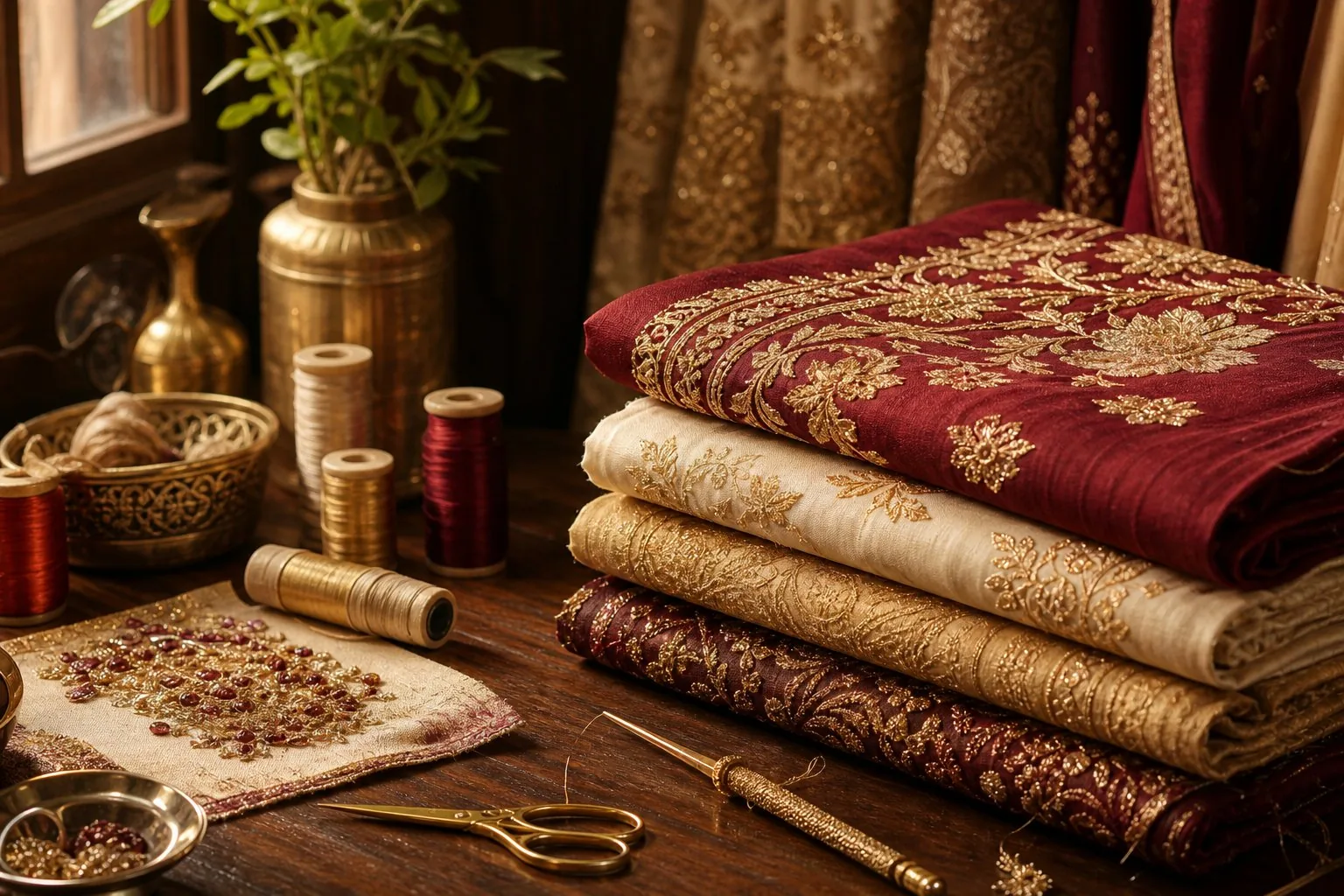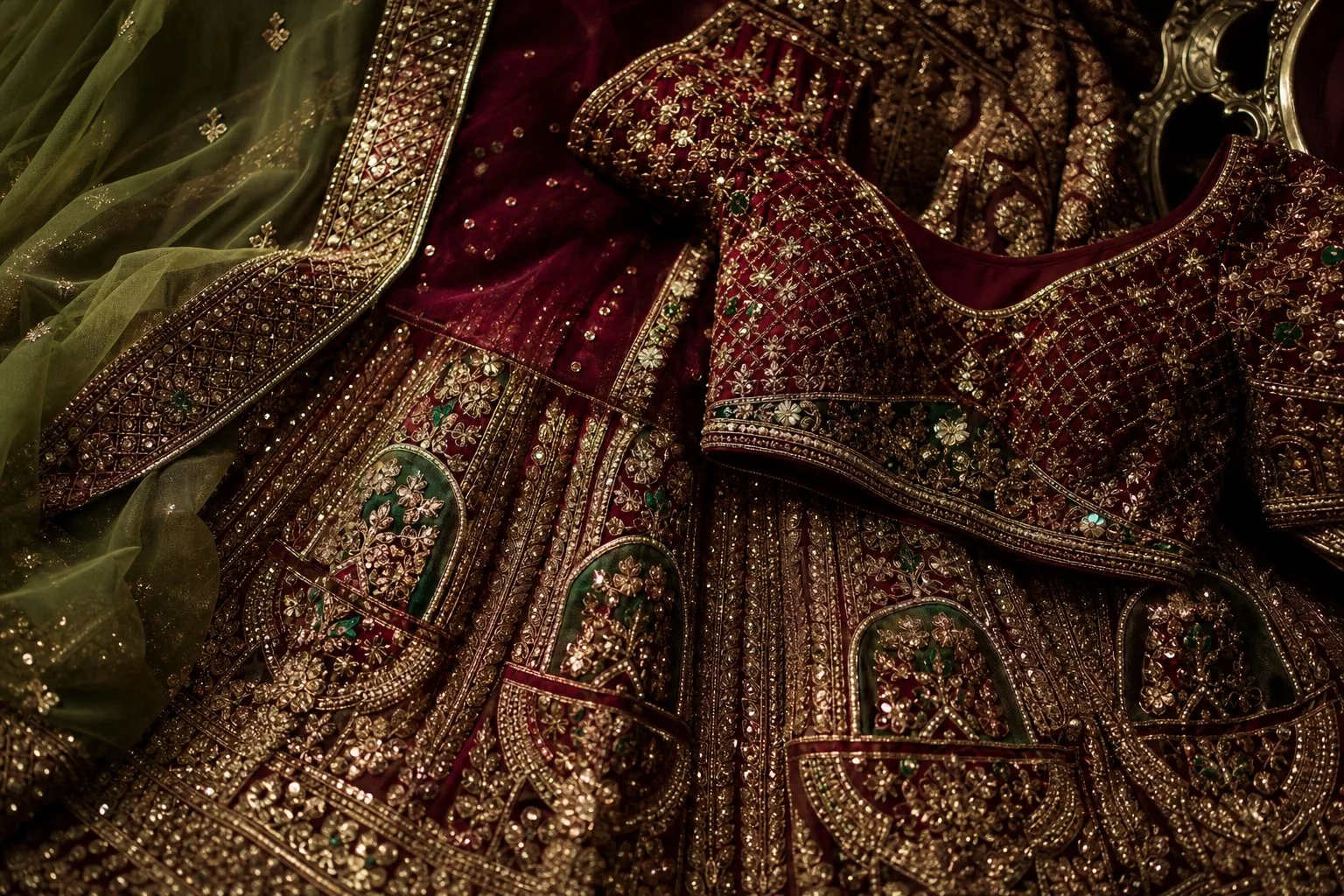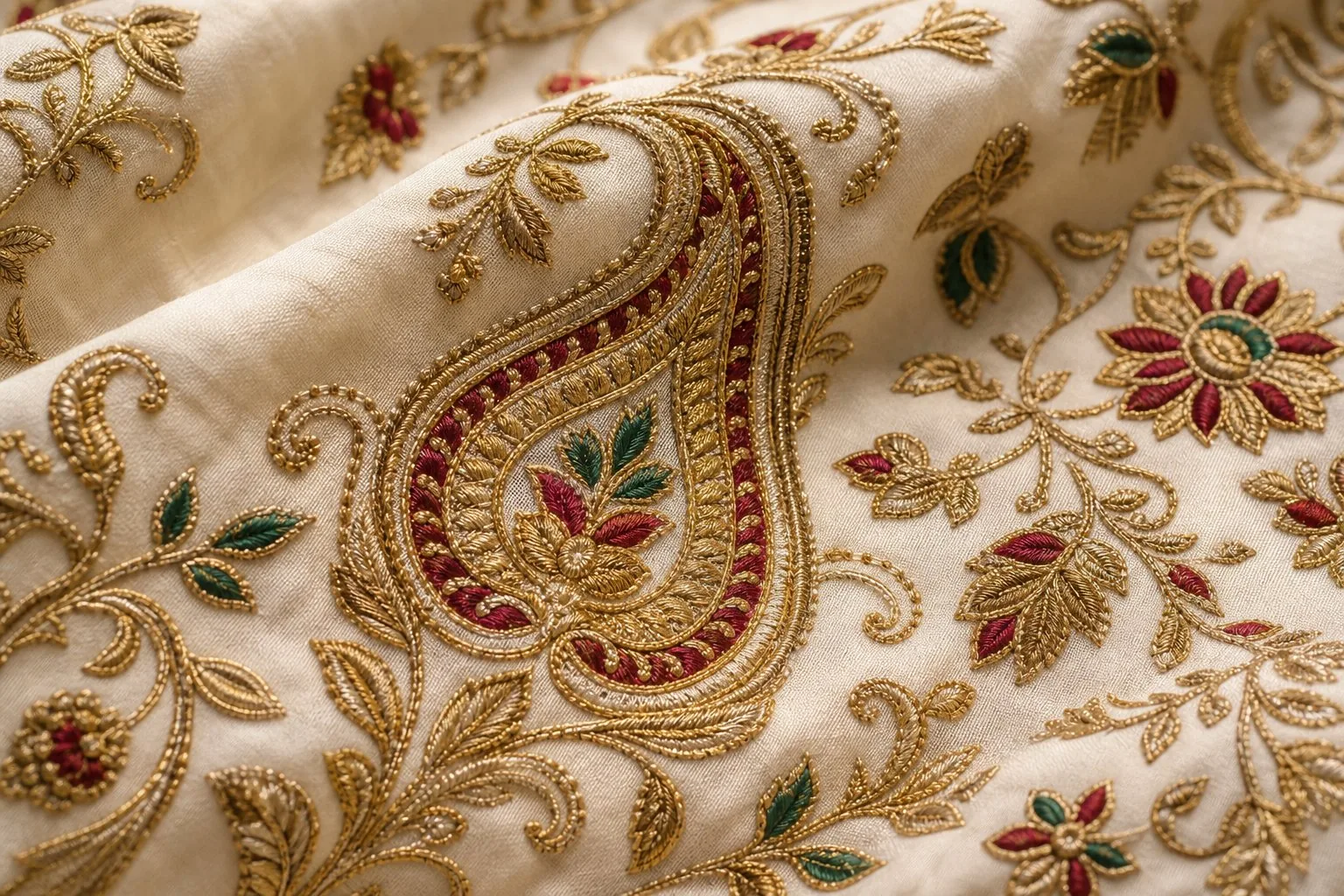
Arabic embroidery from India: abaya, kaftan and jalabiya work
Indian hand embroidery and Gulf design have shared a language for centuries. This guide explains how boutiques and private clients in the UAE, Saudi Arabia, Qatar, Kuwait, Oman and Bahrain commission traditional and contemporary Arabic embroidery from a Mumbai studio — and what to specify so the finished piece arrives exactly right.
Why the Gulf sources embroidery from India
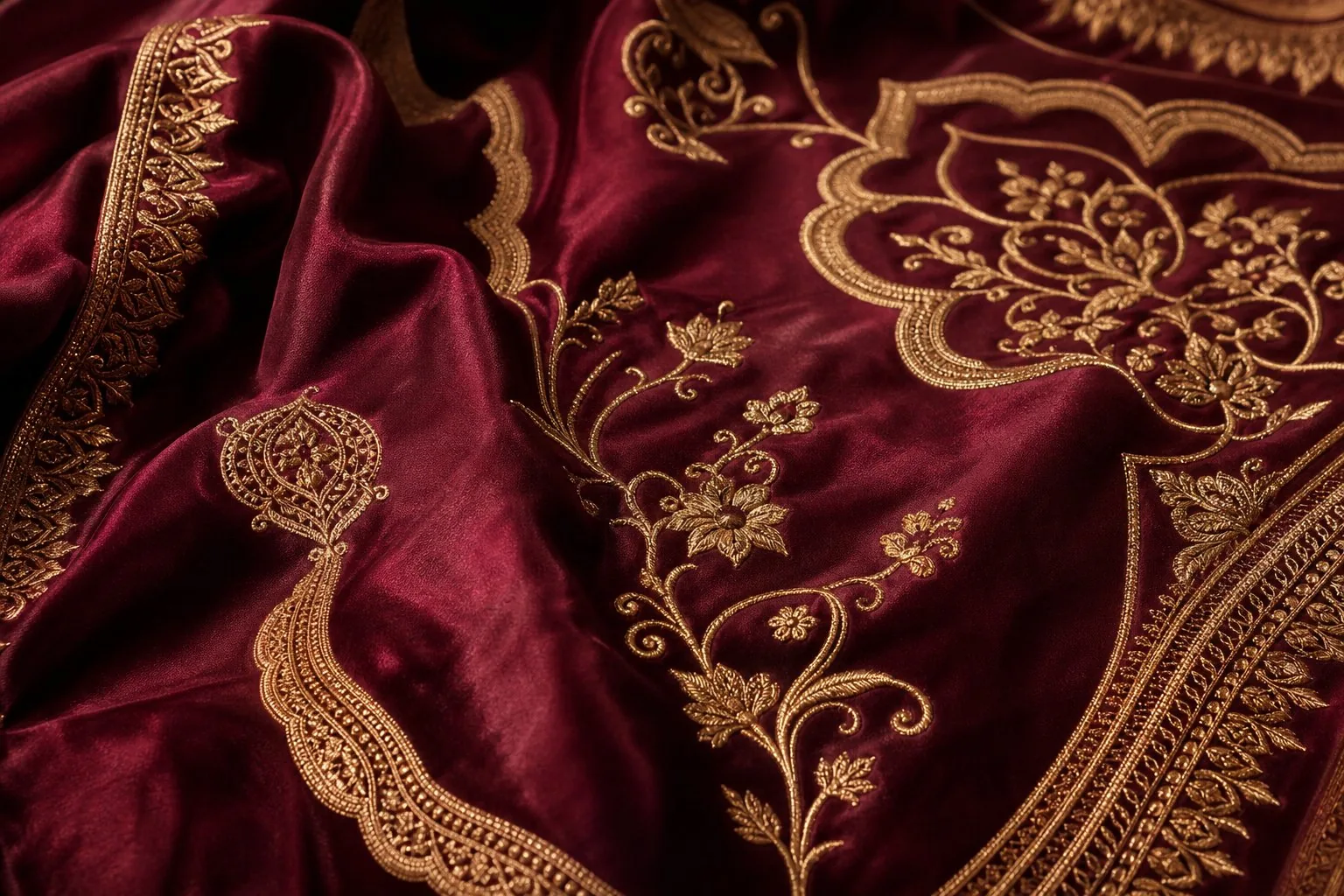
The link between Indian embroidery and Gulf fashion is old and practical. Indian workshops hold deep skill in metal-thread work — zari and zardozi — which is precisely the vocabulary of luxury abaya and kaftan detailing. Add hand-set stones, crystals and beadwork, and you have the finish Gulf customers expect, produced by craftspeople who have worked in that register for generations.
There is also a question of scale. A boutique in Dubai or Riyadh can order a single bespoke piece for a client, or a seasonal run for the shop floor, from the same studio and to the same standard.
Arabic styles we work in
- Classic gold and silver zari. Metal-thread borders, cuffs and panels — restrained, formal and timeless.
- Zardozi. Raised, dimensional metal work for statement pieces and occasion abayas.
- Crystal and stone work. Hand-set stones, crystals and pearls, from a discreet scatter to full sleeve and hem coverage.
- Thread and floral motifs. Fine tonal thread work — often the same shade as the fabric, so the design reads as texture rather than colour.
- Geometric and architectural motifs. Repeating borders and panel work suited to structured cuts.
- Appliqué, patch and lace combinations. Fabric-on-fabric detailing with embroidered edges.
- Monograms and initials. Arabic or Latin script, embroidered on cuffs, plackets or inner labels.
Tonal black-on-black abaya work deserves particular mention: it is the most requested and the least forgiving. Density, sheen and thread choice do all the work, so we almost always sample it before production.
Garments we embroider
- Abaya — sleeves, cuffs, front placket, hem and shoulder panels.
- Kaftan — neckline, yoke, sleeve borders and full-coverage occasion pieces.
- Jalabiya — chest panels, side borders and hem detail.
- Thobe and jalabiya for men — collar, placket and cuff embroidery.
- Shayla and scarves — edge and corner motifs.
- Bridal and occasion gowns — heavy zardozi and stone work.
- Home textiles — majlis cushions, throws and table linen with matching motifs.
Ordering from the Gulf, step by step
- Share the design. A photo, sketch or reference from Instagram is enough to begin. Tell us the garment, fabric, quantity and deadline.
- Receive the quotation. Technique, materials, per-piece cost, sampling cost and estimated timeline, all confirmed before anything starts.
- Fabric. Either courier your own fabric or garments to Mumbai, or ask us to source a suitable base here.
- Sample. We stitch a swatch or a full sample piece and send detailed photographs and video. Physical swatches can be shipped when the shade or sheen must be exact.
- Approval. You confirm thread, stone, density and placement in writing.
- Production. The run is completed with progress updates at agreed stages.
- Shipping. Packed to protect raised work and dispatched with tracking to your address in the Gulf.
Shipping, timelines and customs
- Plan backwards from your date. Allow time for fabric to reach Mumbai, for sampling and approval, for production, and for international shipping.
- Ramadan and Eid demand peaks early. Boutiques ordering seasonal stock should brief us well before the season, not during it.
- Wedding season overlaps with India’s. The Indian peak runs roughly November to February, so early confirmation protects your slot.
- Duties and customs are the receiver’s responsibility in most cases; we provide accurate documentation and invoicing for the shipment.
- Everything is trackable, and we share dispatch details as soon as the parcel leaves.
What to specify in your brief
Gulf orders go smoothly when six things are stated clearly:
- Garment and cut — abaya, kaftan, jalabiya, gown; open or closed front; sleeve style.
- Fabric — nida, crepe, chiffon, silk, velvet. This determines technique more than anything else.
- Finish — tonal and subtle, or bold and high-contrast.
- Embellishment — thread only, or with stones, crystals, pearls or beads.
- Coverage — cuffs and hem only, panels, or full coverage.
- Quantity and sizes — a single bespoke piece, or a graded run across sizes.
Send those six points with a reference image and you will get an accurate quotation on the first reply. See our full service list, or look at technique in the gallery.
Tell us what you want made.
Send a reference photo, your fabric and your deadline. We reply with honest advice and a clear quotation.
Frequently asked questions
Do you ship embroidery to the UAE, Saudi Arabia and other Gulf countries?
Yes. We regularly work with clients in the United Arab Emirates, Saudi Arabia, Qatar, Kuwait, Oman and Bahrain. Finished work is packed to protect raised embroidery and shipped with tracking.
Can you embroider abayas, kaftans and jalabiyas?
Yes. Abaya sleeves, cuffs, plackets and hems, kaftan yokes and borders, jalabiya panels, thobes, shaylas, occasion gowns and matching majlis textiles are all regular work for us.
Can you match a design I saw on Instagram?
Usually yes. Send the image on WhatsApp with your fabric and garment details, and we will confirm what is achievable, suggest any adjustments for your fabric, and quote.
Do you supply the fabric, or do I send my own?
Either. Many Gulf clients courier their own nida, crepe or silk to Mumbai, while others ask us to source a suitable base here. Both are quoted clearly upfront.
What language do you communicate in?
All correspondence is handled in English, over WhatsApp or email, with photographs and video at every approval stage.
Do you take single pieces or only bulk orders?
Both. A single bespoke abaya is as welcome as a seasonal production run for a boutique.
Still have a question? Message us on WhatsApp or send an enquiry.