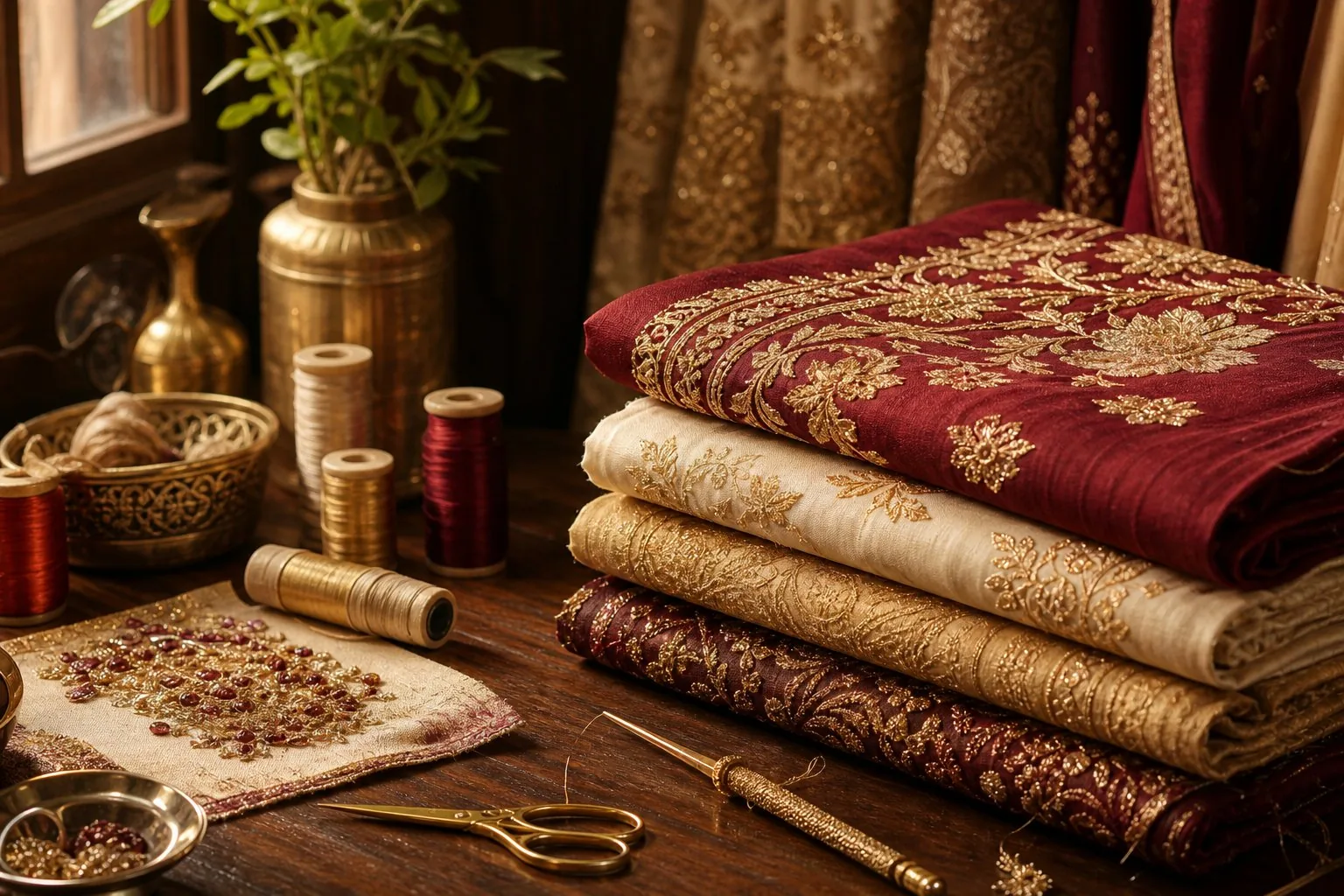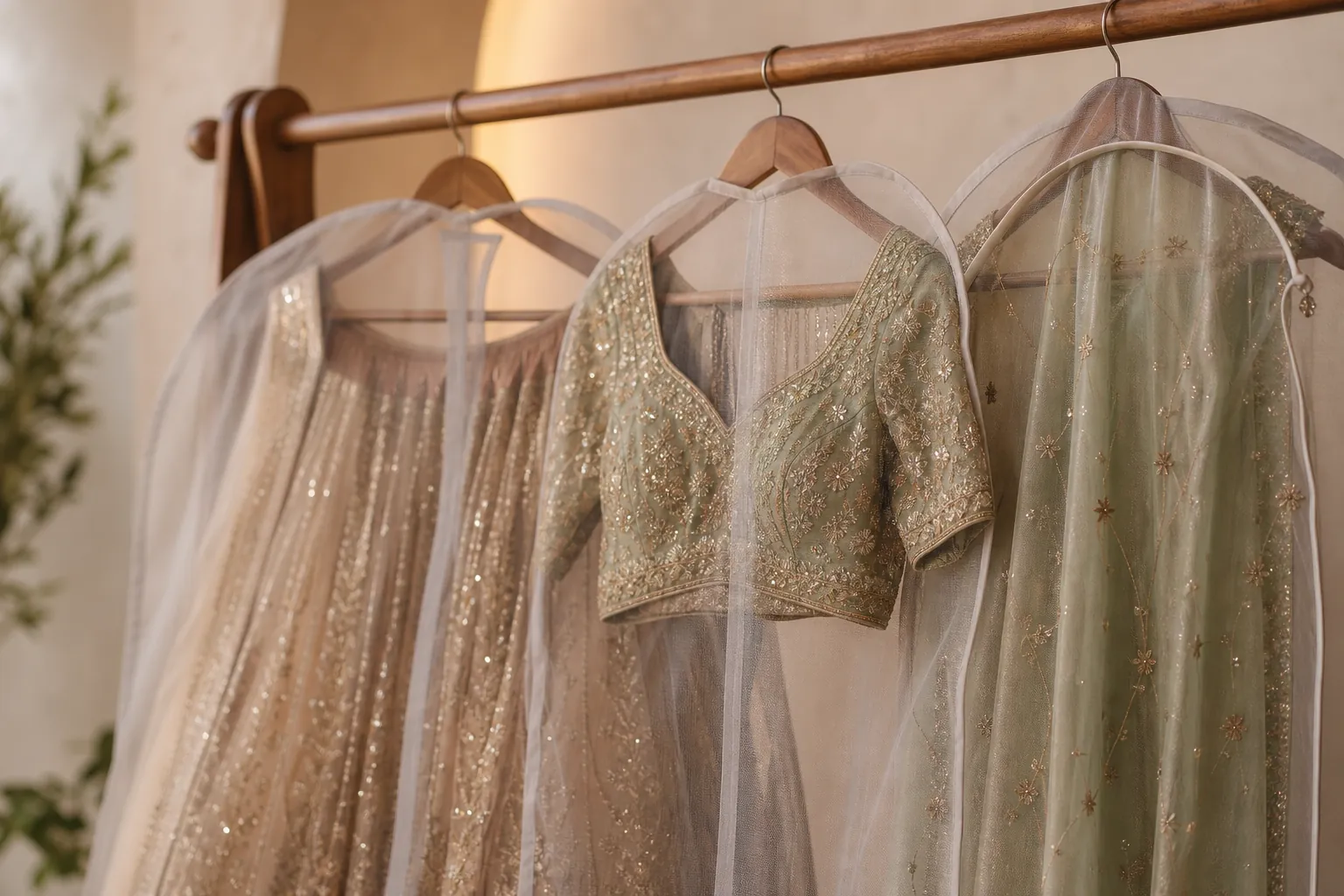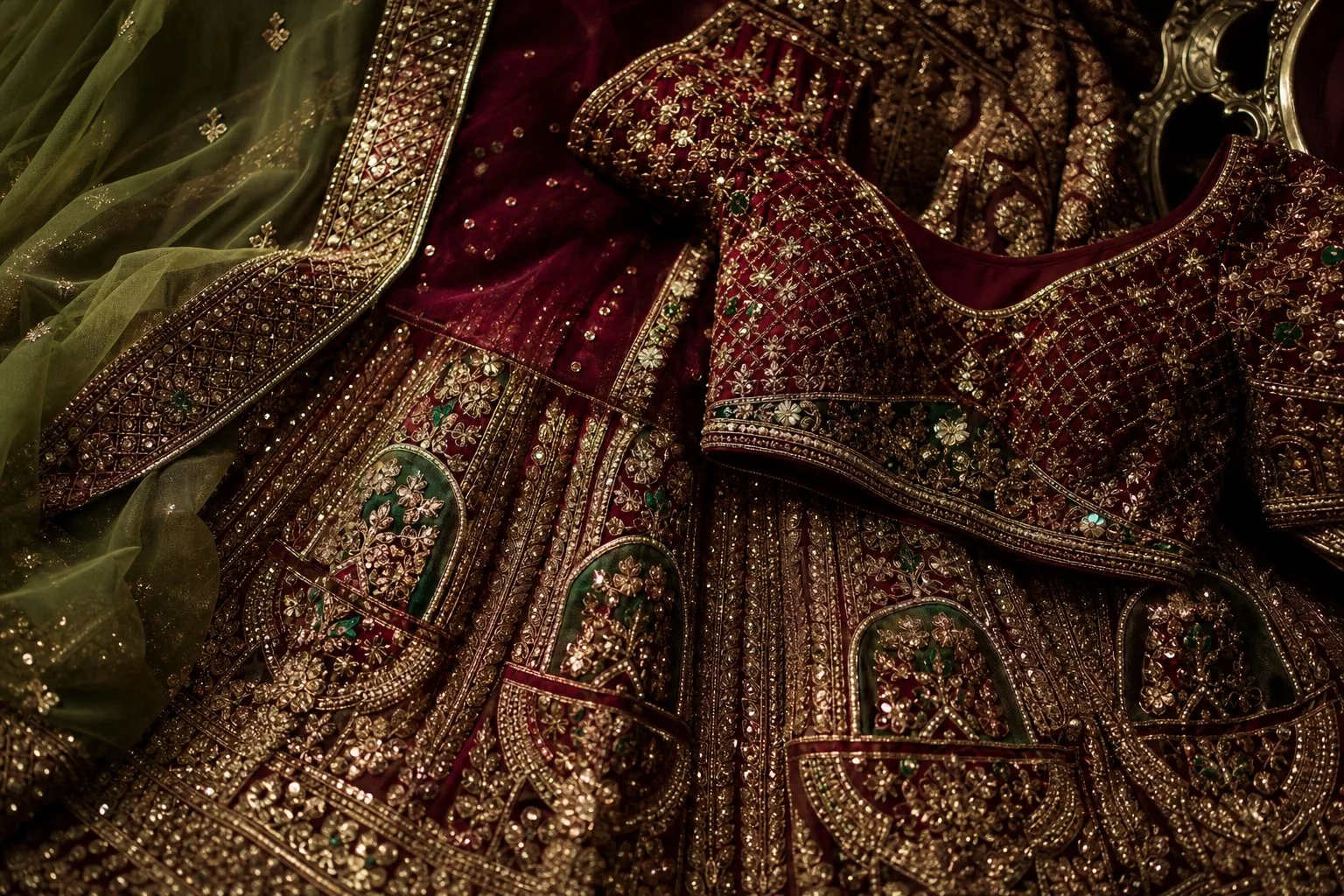
Abaya and kaftan embroidery for Ramadan and Eid 2027
Gulf families order their Eid wardrobe far earlier than most people outside the region realise — and the ones who order from India earliest get both the better price and the better craftsmen. If you are planning for 2027, the work starts now.
Why October matters for an Eid order
Ramadan 2027 is expected to begin in early to mid February, with Eid al-Fitr falling around the second week of March. Exact dates depend on the moon sighting, which is precisely why sensible planning works backwards with a margin rather than to a fixed day.
Count back from there. A well-worked abaya or kaftan needs three to six weeks on the frame. Add a sample approval round, add shipping in both directions, and add a safety buffer for customs. You arrive at November or December as the comfortable commissioning window, and October as the right month to start the conversation.
There is a second reason. Indian ateliers see their own peak between November and February for the wedding season. A Gulf order placed in October or November is scheduled into a calmer calendar than the same order placed in January.
Working backwards from Eid
- October — send references and photographs, agree technique and receive a quotation.
- November — confirm the design, settle the base fabric, and courier fabric to Mumbai if you are supplying your own.
- December — we stitch a sample on your actual fabric and photograph it. Nothing scales until you approve it.
- December to January — the embroidery itself, with progress photographs at agreed points.
- Late January — finishing, inspection front and back, pressing and packing.
- Early February — shipped, with time to spare before Ramadan begins.
Leaving it until January is not impossible, but it removes the sample round, which is exactly the step that protects you when you are commissioning from another country.
What people actually order
Eid ordering is rarely a single piece. The most common brief is a small family group that needs to look related without being identical.
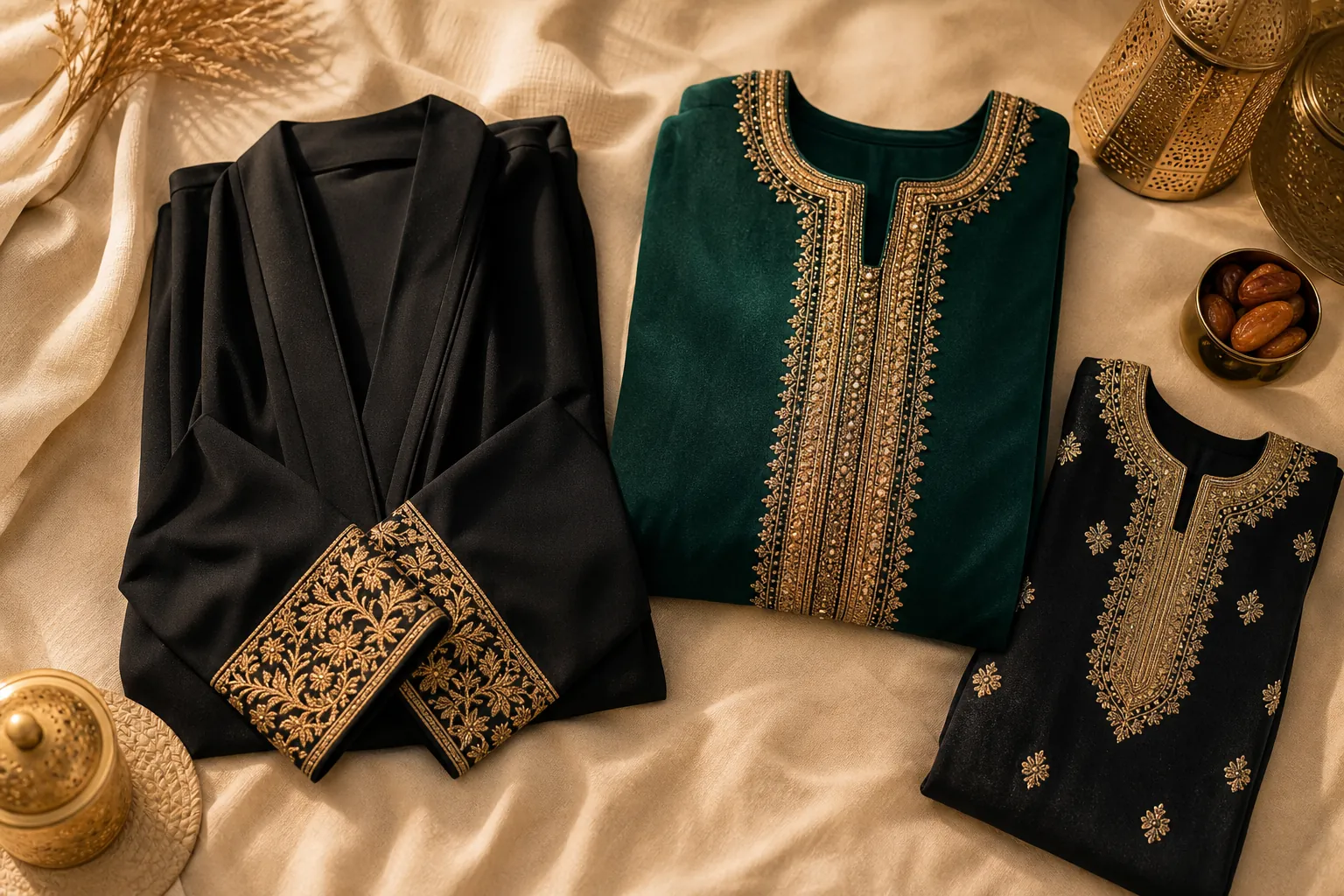
- Abaya — cuff, hem, sleeve and front panel work, from very restrained to heavily embellished.
- Jalabiya and kaftan — placket, neckline and full panel goldwork, often the centrepiece of the wardrobe.
- Thobe and kandura — fine, restrained neckline and placket work where precision matters more than ornament.
- Children’s pieces — scaled-down versions of the adult design, which must be re-set rather than simply shrunk.
- Family sets — a shared motif or palette carried across several garments at different weights.
- Boutique runs — Gulf retailers ordering a season’s stock, sized and packed per piece.
Traditional Khaleeji or contemporary
These are two different crafts and should not be treated as interchangeable. Traditional Khaleeji work has its own grammar — dense gold panels running down the placket, scalloped neckline edging, deliberate formality. Contemporary arabesque is the opposite instinct: flowing, open, confident in its negative space.
We work both, and we will tell you which suits the garment and the occasion. A common and very effective brief is traditional goldwork on the main Eid piece, and something lighter and more modern on the garments worn through Ramadan itself.
If you want a specific traditional style matched exactly, send a photograph of the piece. Matching an existing panel is routine work, and the sample round exists precisely so you can confirm it before the full garment is committed.
Shipping, customs and the buffer
Courier to the UAE, Saudi Arabia, Qatar, Kuwait, Oman and Bahrain typically takes three to six working days each way. The variable is not usually the airline, it is customs clearance.
- Build in two weeks of buffer beyond the courier estimate. You will almost never need it, and the one year you do, you will be glad.
- Import duty is the receiver’s responsibility and varies by declared value and category. We declare shipments accurately and give you the figures in advance.
- Shipping fabric to us adds a leg. If you would rather not, we can source comparable base fabric in Mumbai and photograph options for you.
- Avoid arrival in the final week before Eid. Every courier route in the region is congested then.
Approving work from another country
The reasonable worry about ordering abroad is that you cannot see the work until it arrives. The answer is not reassurance, it is evidence at every stage.
We stitch a sample on your actual base fabric and photograph it in natural light. For larger commissions we send progress photographs at agreed points rather than only at the end. Colour is the one thing a screen will always misrepresent, so where it matters we post physical thread and fabric swatches before starting — a few days in the post that removes the single biggest cause of disappointment.
For boutiques and designers we work under NDA as standard, and no client commission is ever displayed or shown to another customer.
Tell us what you want made.
Send a reference photo, your fabric and your deadline. We reply with honest advice and a clear quotation.
Frequently asked questions
When exactly is Eid al-Fitr 2027?
It is expected around the second week of March 2027, with Ramadan beginning in early to mid February. Dates depend on the moon sighting, so plan with a buffer rather than to an exact day.
How late can I place an Eid order?
January is workable for a single straightforward piece, but it usually means skipping the sample round. For family sets or heavy goldwork, December is the practical cut-off.
Can you match a traditional Khaleeji design exactly?
Yes. Send a clear photograph of the panel or garment. We stitch a sample on your fabric for approval before committing the full piece.
Do you supply the abaya fabric or do I send it?
Either. Many clients courier their own fabric or an existing garment; others ask us to source comparable base fabric in Mumbai and send photographs of the options.
Who pays customs duty?
Import duty into the Gulf is the receiver’s responsibility and varies by value and category. We declare accurately and give you the details in advance so there are no surprises on arrival.
Can you make matching pieces for a whole family?
Yes, and it is one of the most common Eid briefs. A shared motif or palette carried across adult and children’s garments, with each piece re-set to its own proportions rather than scaled.
Still have a question? Message us on WhatsApp or send an enquiry.